


Skilled Migrant Category (SMC)
New Zealand Skilled Migrant Category
The Skilled Migrant Category (SMC) is New Zealand’s main residence pathway for skilled migrants. The Points-based pathway is not limited to a specific list of occupations, and most post-study migration goes through the SMC. The key is to earn points from one of three categories (qualifications, occupational registration or income) and add New Zealand work experience to reach a total of 6 points. Two further pathways, Skilled Work Experience and Trades and Technician, let you qualify through work experience instead of points.
An SMC Resident Visa lets you live, work and study in New Zealand indefinitely and include your partner and dependent children aged 24 or younger in your application. This page is updated for the changes that took effect on 24 August 2026.
Before you start: requirements
Points are calculated only after you meet the requirements below. Employment is the real starting point. Even with strong qualifications and experience, you need a confirmed job from a New Zealand employer, so most preparation begins with planning how to get to that job.
Age
55 or under
English
IELTS 6.5 or equivalent
Health
Meet Immigration New Zealand’s health requirements
Character
No character issues (e.g. criminal record)
Employment
A job or job offer from an accredited employer
If you hold occupational registration, your English test result is valid for 5 years.† (See “Occupational registration” below.)
How does the 6-point system work?
Choose one of qualification, NZ occupational registration or income, then add New Zealand work experience to reach 6 points. Points from qualification, registration and income cannot be combined. For example, 4 points for a qualification plus 3 points for income does not make 7. Only the most favourable one counts, and the only thing you can add is New Zealand work experience points.
6
PhD (Level 10); NZ master’s (30+ weeks full-time)
Registration requiring 6+ years’ training
3× the threshold
(from NZ$105.00/hr)
None
5
Overseas master’s (Level 9); NZ bachelor’s (Level 7), bachelor’s honours, PGDip, PGCert
Registration requiring 5+ years’ training
–
1 year
4
Overseas bachelor’s, bachelor’s honours, PGDip, PGCert
Registration requiring 4+ years’ training
2× the threshold
(from NZ$70.00/hr)
1.5 years
3
–
Registration requiring 2+ years’ training
1.5× the threshold
(from NZ$52.50/hr)
2 years
Qualifications
Overseas qualifications must be assessed through an International Qualification Assessment (IQA) or be listed on the List of Qualifications Exempt from Assessment (LQEA). An IQA is not required for the supporting bachelor’s degree. A New Zealand qualification generally earns more points than the overseas equivalent.
NZ occupational registration
This applies to occupations that require registration in New Zealand, such as nurses, teachers, engineers and accountants. Accountants who can undertake the work of a Qualified Statutory Accountant in New Zealand and hold CPA Australia membership are also eligible.
Income
Your employment must be with an accredited employer, full-time (30+ hours per week) and on an employment agreement of 12 months or more.† The SMC wage threshold shown on this page is current as of October 2026.
New Zealand work experience
This is the only category that can be added to the points above, and only skilled work experience gained in New Zealand counts.
- 3 points: 2 years of skilled work experience in New Zealand, gained within the last 4 years
- 2 points: 1.5 years, gained within the last 3 years
- 1 point: 1 year, gained within the last 2 years
What counts as work experience
To count, your work experience must meet the wage threshold for your job’s ANZSCO skill level:
- Skill level 1–3: at least the SMC wage threshold (from NZ$35.00/hr)
- Skill level 4–5: at least 1.5× the SMC wage threshold (from NZ$52.50/hr)
In most cases, you only need to meet the wage threshold that applied when you started building your skilled work experience. You do not need to meet a higher threshold when you apply for residence. If you start work within 5 months of your work visa being granted, the threshold in effect on the day your visa was granted applies, even if the threshold has since increased.
Points calculation examples
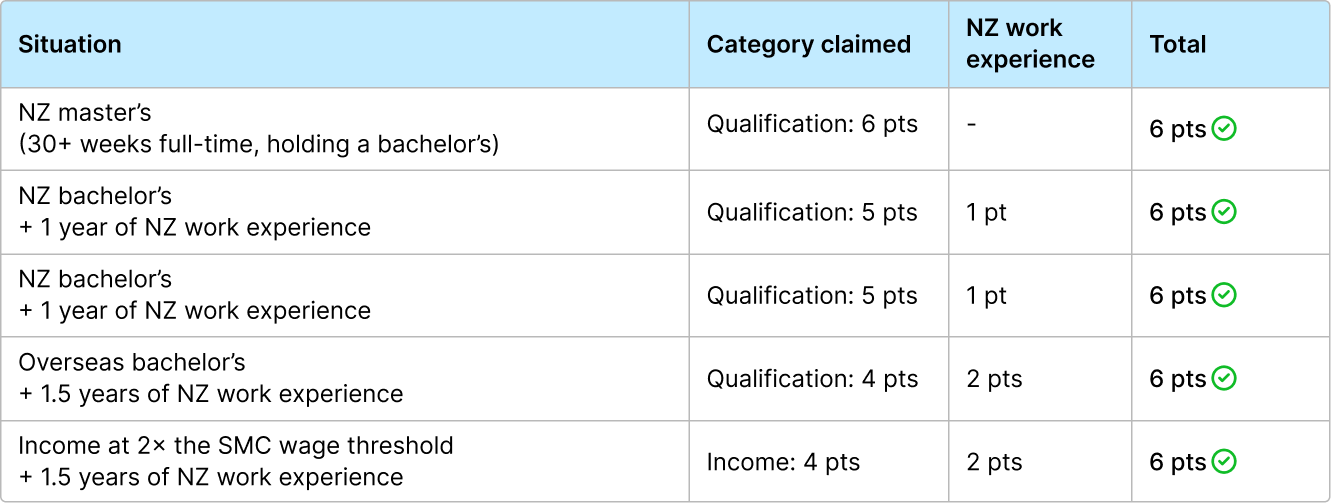
Your actual points depend on the country and type of your qualification, your occupation and your pay level.
Work experience and trades pathways
Besides the 6-point system, the SMC has two more pathways. Skilled Work Experience assesses work experience and does not require a qualification. Trades and Technician is for people in eligible trades and technician roles. It requires a Level 4 or higher qualification plus post-qualification work experience, and the eligible occupations are set by Immigration New Zealand. Check eligible Trades and Technician occupations →
Who it’s for
People in skilled occupations at ANZSCO skill level 1–3
People in eligible trades and technician occupations on INZ’s list
Qualification
None required (assessed on work experience)
Relevant qualification at Level 4 or higher
Work experience
At least 5 years in total
At least 4 years of post-qualification experience in total
NZ Work experience
At least 2 years
At least 1.5 years
Pay
At least 1.1× the SMC wage threshold
At least the SMC wage threshold
Red List and Amber List
The Red and Amber Lists apply to the Skilled Work Experience pathway only. Think of them as traffic lights: Amber means you can proceed under stricter conditions, and Red means this pathway is closed.
- Red List: You cannot use the Skilled Work Experience pathway. The same applies to occupations at ANZSCO skill level 4–5. You may still be able to apply through the Points-based pathway.
- Amber List: You can use the Skilled Work Experience pathway under stricter conditions: pay of at least 1.2× the SMC wage threshold, at least 3 years of relevant work experience in New Zealand, and an additional 2 years of skilled work experience in New Zealand paid at least 1.2× the threshold. The Points-based pathway is also available, and we recommend it for the occupations below.
Accommodation
Hotel or Motel Manager, Hotel Service Manager, Bed and Breakfast Operator, Caravan Park and Camping Ground Manager, Accommodation and Hospitality Manager nec
Amber
Cooking and food
Chef, Baker, Pastrycook, Café or Restaurant Manager
Amber
General management
Customer Service Manager, Office Manager
Amber
General management
Retail Manager (General), Hospitality, Retail and Service Manager nec
Red
Beauty and health
Hairdresser, Beauty Therapist, Massage Therapist, Hair or Beauty Salon Manager
Red
ICT
ICT Customer Support Officer, ICT Support Technicians nec, Web Administrator
Amber
SOL Licensed Immigration Advisers
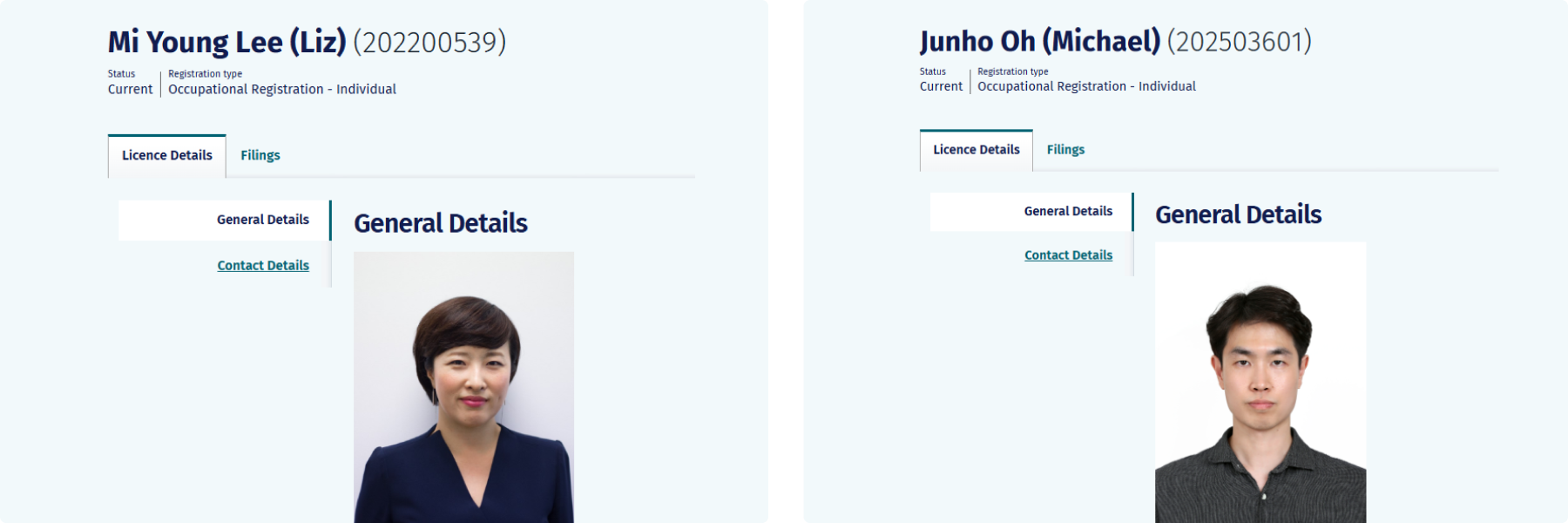
In New Zealand, providing immigration advice or handling visa applications requires a Licensed Immigration Adviser (with limited exemptions, such as New Zealand lawyers). Licensing is managed by the Immigration Advisers Authority (IAA), and unlicensed immigration advice is prohibited by law. Before you consult anyone, confirm that your adviser is licensed. You can search the IAA register by name or licence number.
In-house immigration advisers, not outsourced
SOL has 9 licensed immigration advisers and does not outsource immigration advice. Licensed advisers are based in both New Zealand and Australia, so visa refusals, changes of conditions and residence strategy are handled immediately, with no hand-off to a third party. Because advisers are involved from the study consultation stage, you can check from day one whether a course can lead to residence.

Miyoung Lee, Licensed Immigration Adviser
Based in Auckland
Licence no. 202200539
Specialties: SMC, Green List, post-study migration

Junho Oh, Licensed Immigration Adviser
Based in Seoul
Licence no. 202503601
Specialties: SMC, Green List, post-study migration
Frequently asked questions
Q. Can I still apply if I don’t have 6 points?
Even if your points fall short today, you can build New Zealand work experience or gain an additional qualification to raise your qualification points. A work-experience pathway or the Green List may suit you better, so the right strategy depends on your situation.
Q.Are my overseas qualifications recognised?
They are recognised if they are assessed through an IQA or appear on the LQEA. Qualifications gained in New Zealand generally earn more points, so if you’re short on points, studying in New Zealand may be worth considering.
Q. Can I apply without a job offer?
The SMC is based on employment with an accredited employer. Routes that don’t require a job, such as investment or business visas or partnership-based visas, are different pathways.
Q. How long does it take to get residence?
It depends on your starting point. Graduates of a New Zealand master’s who reach 6 points immediately have the shortest path. If you need to build work experience, expect 1–2 more years. Reaching the SMC wage threshold also matters, so discuss with an adviser which occupations make that easier.
